Available Now at Northeast Music Center!
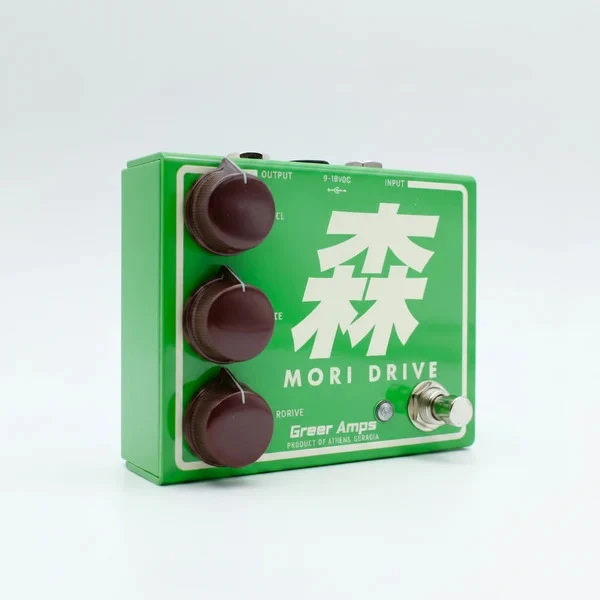
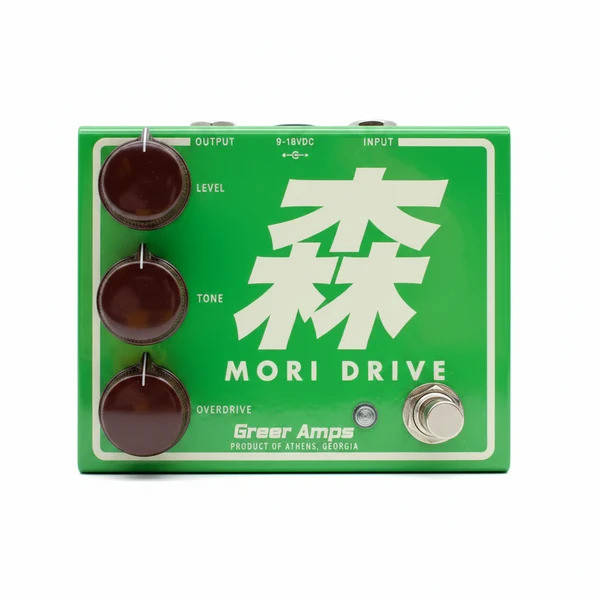
Greer Amps Mori Drive
A Classic Mid-Focused Overdrive—Given the Greer Treatment
There are certain overdrive circuits that have become part of the language of electric guitar.
You know the sound.
A focused midrange that pushes the guitar forward.
A little tightening of the low end.
Enough compression and saturation to make a tube amp feel like it's working harder.
And that unmistakable ability to push an already cooking amplifier into the sweet spot.
The Greer Amps Mori Drive starts with that familiar idea and takes it somewhere distinctly Greer.
Available now at Northeast Music Center, the Mori Drive was inspired by vintage TS-style circuitry, but Greer didn't set out to simply build another recreation of a familiar green overdrive.
Instead, the circuit was tuned to sit between traditional TS and K-style frequency ranges, with a carefully positioned midrange focus, increased output capability and modified clipping designed to produce a smoother, more natural-feeling drive.
The result is a pedal that feels familiar almost immediately—but doesn't sound like every other mid-focused overdrive already on your board.
"Mori" — Forest
The name Mori comes from the Japanese word meaning "forest."
It's a fitting name for an overdrive designed around texture, layering and organic response.
And those qualities become especially apparent when you start combining the Mori Drive with an amplifier that's already beginning to work—or stacking it with other gain pedals.
This isn't necessarily an overdrive that needs to dominate your rig.
It can become the piece that makes everything around it work better.
Greer's Take on the Famous Mid Hump
Guitarists had been asking Greer for years to create its own interpretation of the classic mid-hump overdrive.
Eventually, Greer landed on a combination of modifications that fit naturally alongside the company's existing drive pedals.
That became the Mori Drive.
The basic DNA will be familiar to players who know classic TS-style circuits, but the frequency response has been deliberately adjusted.
Greer positions the Mori's voicing between TS-style and K-style frequency ranges.
That distinction matters.
The Mori still gives you the focused midrange that makes this family of overdrive so useful, but the hump has been positioned in what Greer describes as a particularly musical part of the frequency spectrum.
Rather than feeling overly congested or nasal, the mids help the guitar occupy its own space.
In a full band mix, that's exactly what a good mid-focused overdrive should do.
JRC4558-Based Circuit
At the heart of the Mori Drive is the classic JRC4558 integrated circuit.
That chip has an enormous history in overdrive design, but the chip alone doesn't determine how a pedal sounds.
The surrounding circuit and the way the designer voices it are what turn familiar components into a particular pedal.
That's where the Mori becomes interesting.
Greer has years of experience modifying and building TS-inspired circuits, and the Mori represents the company's preferred collection of tweaks to that basic architecture.
Think of it less as Greer reproducing a vintage circuit and more as Greer asking:
"If we were going to make this type of overdrive fit our own lineup, what would we change?"
The Mori Drive is the answer.
Asymmetrical Clipping
Greer uses asymmetrical clipping in the Mori Drive to help create a smoother, more natural drive character.
That changes the texture of the distortion.
Instead of feeling excessively uniform or compressed, the drive can retain a more organic quality as notes bloom and decay.
This becomes particularly useful when the pedal is pushing a tube amplifier.
A great boost/overdrive combination shouldn't necessarily sound like a pedal sitting on top of the amplifier.
It should feel as though the amplifier itself has suddenly become more alive.
That's exactly the territory the Mori is designed to explore.
More Output Than a Traditional TS-Style Drive
One of Greer's important changes is additional available output volume compared with a standard TS-type circuit.
That gives the Mori Drive considerably more flexibility.
You can certainly use it as a conventional overdrive.
But you can also turn the gain down, increase the output and use the Mori to push the front end of an amplifier.
That additional level becomes especially useful with tube amps that already sound good when driven hard.
Instead of getting all of your saturation from the pedal, the Mori can push the amplifier farther into its own natural breakup.
The pedal and amp begin working together.
And that's where some of the best overdrive sounds live.
Wide Sweet-Spot Tone Control
Some tone controls seem to have one small usable area surrounded by settings you'll never touch.
The Mori Drive was designed with a wide sweet spot.
That means the Tone control isn't there simply to correct a problem.
It's there to let you shape how the pedal interacts with different guitars, pickups and amplifiers.
A bright single-coil guitar going into an already articulate amplifier may want one setting.
A warm humbucker into a darker amp may need something completely different.
The Mori gives you room to make those adjustments without losing the fundamental character of the pedal.
Made to Push an Amp
The Mori Drive becomes particularly interesting when you stop thinking of it as an isolated distortion box and start thinking of it as part of the amplifier.
Set the amp near breakup.
Bring in the Mori.
Now you're using the pedal's midrange emphasis, clipping character and additional output to change how the front end of the amplifier reacts.
The lows can tighten.
The mids move forward.
Notes become more immediate.
The amplifier compresses differently.
And lead lines can gain sustain without disappearing underneath excessive saturation.
That's why this style of overdrive has remained relevant for decades.
Done properly, it doesn't replace the sound of a great amp.
It helps you get more out of it.
An Excellent Stacking Pedal
This may be one of the Mori Drive's strongest features.
It stacks exceptionally well.
Greer specifically developed the circuit to work alongside other drive pedals, and that opens up a tremendous amount of flexibility on a pedalboard.
Use the Mori before another overdrive to change what that pedal sees.
Place it after another drive to reshape and boost the combined signal.
Run it into an already driven amplifier.
Or build several levels of gain using multiple pedals.
Each approach produces a different result.
At Northeast Music Center, this is exactly the kind of pedal we like because it doesn't have to replace something you already own.
It can make the pedals already on your board more useful.
Mori + Lightspeed + Southland
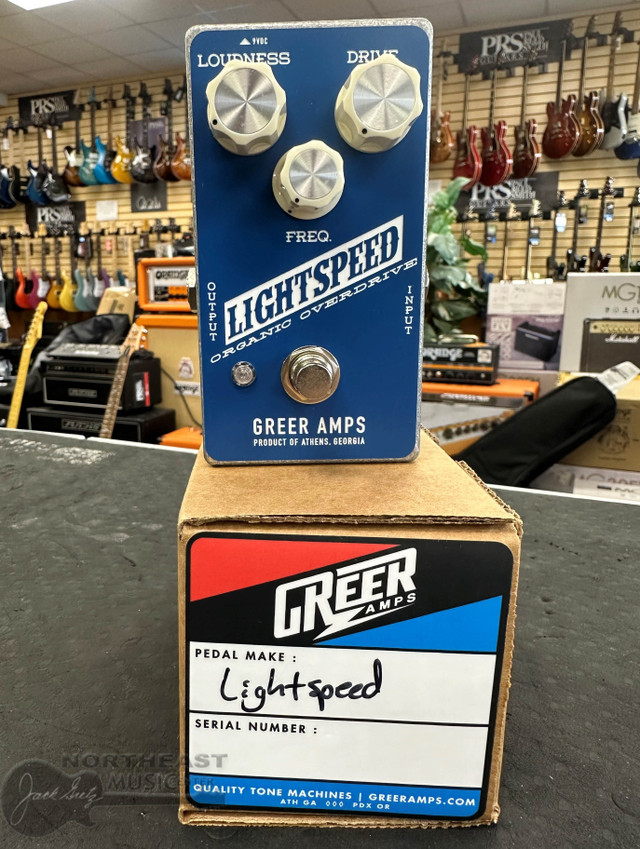
If you're building a Greer-based gain section, the combination of the Mori Drive, Lightspeed Organic Overdrive and Southland Harmonic Overdrive provides an enormous amount of tonal territory.
The Lightspeed can provide transparent, touch-sensitive drive.
The Southland can bring a more aggressive harmonic voice.
The Mori adds the focused midrange character and ability to push the rest of the chain.
Use them individually and you have several distinct gain voices.
Start stacking them and the number of available textures expands dramatically.
This is where the Mori's smooth clipping and carefully voiced midrange become particularly valuable.
It can become the glue between different gain sounds rather than simply another variation of the same thing.
True Bypass
The Mori Drive features true-bypass switching, allowing your signal to pass through without the effect circuit engaged when the pedal is switched off.
For players building larger analog boards or carefully managing their signal chain, that's an important practical feature.
9–18 Volt Operation
The Mori can operate from 9 to 18 volts DC, using a standard center-negative 2.1mm power supply.
At 9 volts, current draw is only 7mA.
At 18 volts, current draw is approximately 9mA.
The pedal can also operate from a 9-volt battery.
The ability to run at different supply voltages gives players another way to experiment with how the pedal responds within their rig.
Built with Quality Components
Greer Amps builds the Mori Drive using high-quality components and backs the pedal with a 5-year warranty to the original owner.
That's exactly what we'd expect from a pedal designed to live on a working musician's board.
This isn't supposed to be something you baby.
It's supposed to be stepped on.
Why Buy Your Greer Amps Pedals from Northeast Music Center?
At Northeast Music Center, we're not interested in describing every overdrive pedal as revolutionary.
Some of the best pedals aren't about reinventing overdrive.
They're about taking an established idea, understanding exactly why guitarists love it and refining the details until it becomes something you'll actually use.
That's what Greer has done here.
And whether you're building a complete Greer gain section or simply looking for the right mid-focused drive to push your favorite amplifier, Northeast Music Center is proud to offer the Mori Drive.
Specifications
General
- Manufacturer: Greer Amps
- Model: Mori Drive
- Effect Type: Overdrive
- Circuit Inspiration: Vintage TS-Style Overdrive
- Voicing: Tuned Between Traditional TS and K-Style Frequency Ranges
- IC: JRC4558
- Clipping: Asymmetrical
- Bypass: True Bypass
- Construction: High-Quality Components
- Warranty: 5 Years to Original Owner
Controls
Power
- Operating Voltage: 9–18V DC
- Polarity: Center Negative
- Power Connector: 2.1mm
- Current Draw @ 9V: 7mA
- Current Draw @ 18V: 9mA
- Battery Operation: 9V Battery Compatible
Dimensions
- Width: 3.68"
- Length: 4.67"
- Height: 1.18"